
How to compare 1win and Stake without inventing a winner
You find two prices for the same CS2 or Dota 2 selection. The useful question is which price can actually be accepted under the same settlement rules, not which operator has a reputation for being “sharp”. Compare the contract, available stake and current terms before treating the displayed numbers as equivalent.
This is a reproducible comparison method, not a report of collected 1win or Stake quotes. No 100-series or 100-map dataset is published here. All numerical examples are hypothetical and are not attributed to either operator. They cannot establish average margins, market counts, acceptance speed, withdrawal time or a permanent ranking.
The display order on this site is editorial. It does not tell you which current quote is better. Use the line-shopping guide for the wider workflow, and keep the underlying observations if you want to publish a comparison others can check.
Specify the sample before collecting prices
A proposed study could separate pre-match series from live maps. Define games, tournaments, patch range, markets, observation times and account conditions in advance. “100 series and 100 live maps” can be a sampling target, but the number itself does not prove representativeness or provide a confidence interval. Include observations where a market is unavailable or suspended rather than silently selecting only convenient quotes.
For each quote, preserve event and market IDs, selection, settlement rules, decimal odds, source and timestamp. Record available stake, whether the quote was merely displayed or accepted, and any account-specific boost. A screenshot can document a displayed price; it does not establish what another account could execute. For live observations, save game state and the delay of the source used to observe it.
Choose comparable checkpoints and a rule for matching observations across operators. A quote before a pistol result and one after it are different states. If a source is behind the game, mark that limitation instead of deciding the other operator has slow prices. Separate ordinary quotes from promotions so the reader can see what was compared.
Overround is a property of the complete market
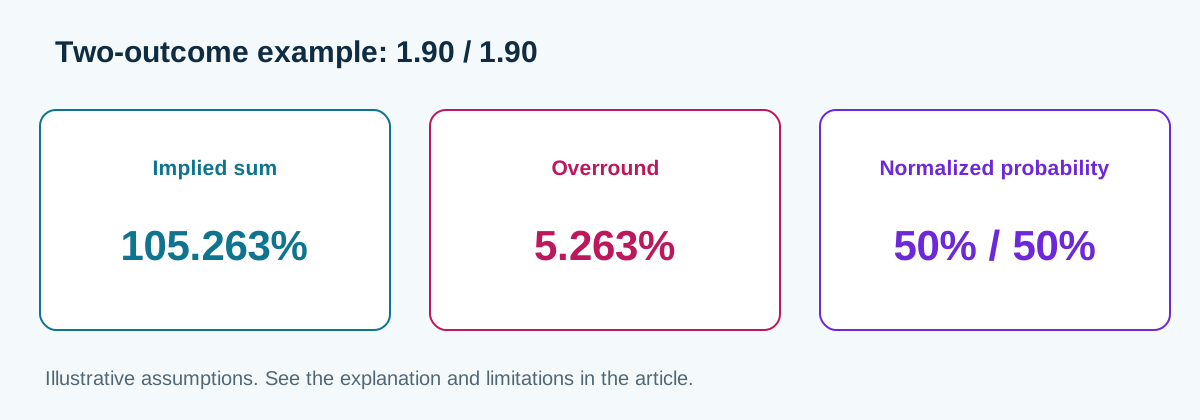
For mutually exclusive, exhaustive outcomes with decimal odds o_i, define S = Σ(1/o_i). Overround is S − 1; the normalized hold transformation is 1 − 1/S. Do not compare one operator's overround with another's normalized hold. Neither is the observed loss rate of every bettor.
| Hypothetical market | A odds | B odds | Overround | Normalized hold |
|---|---|---|---|---|
| Quote set A | 1.90 | 1.90 | 5.263158% | 5.000000% |
| Quote set B | 1.95 | 1.85 | 5.336105% | 5.065789% |
Set A has the lower overround, but set B pays more for selection A. A bettor choosing A compares 1.90 with 1.95, not just the booksum. If the assumed true probability were 0.52, expected return would be 0.52 × 1.90 − 1 = −1.20% at the first quote and 0.52 × 1.95 − 1 = +1.40% at the second. The probability is an input, not something this table measured.
Use the odds and margin converter to reproduce a complete two-way comparison. Removing overround supplies a model of fair probabilities; it does not reveal the true probability automatically. Proportional, Power and Shin methods use different assumptions. Report the method instead of calling a model output independently verified value.
Keep booksum changes separate from side-price changes
Consider exactly 500 hypothetical wagers of $100, with 270 wins and 230 losses. Hold the outcomes fixed and change only the price. The figures below are a scenario calculation, not a simulation of an unknown true win rate and not an observed customer record. Intermediate values use unrounded odds.
| Scenario | Accepted odds | Net profit | ROI |
|---|---|---|---|
| A: symmetric 4.5% overround | 1/0.5225 = 1.913875598 | $1,674.64 | 3.349282% |
| B: symmetric 6.0% overround | 1/0.53 = 1.886792453 | $943.40 | 1.886792% |
| C: selected-side implied probability 53.75% | 1/0.5375 = 1.860465116 | $232.56 | 0.465116% |
In every row, net profit is 270 × (odds − 1) × $100 − 230 × $100. Moving from A to B raises the total symmetric booksum by 1.5 percentage points and reduces the scenario profit by about $731.24. Moving from A to C adds 1.5 points to the selected side's implied probability and reduces profit by about $1,442.08. These are different changes; neither is a universal cost of “1.5% extra margin”.
The 54% win fraction is stipulated for this fixed record. It is not evidence that a bettor has a 54% true win probability, that the outcome sequence will repeat, or that either operator offers these prices. With different outcomes or prices, the money differences change. A higher accepted price improves the payoff of the same winning contract, but it cannot guarantee the contract will win.
Market depth needs evidence as well
If you compare menu breadth, define what counts as a market. Do not count each alternative handicap or reopened live quote as an independent category without saying so. Save the same event and time at both operators, distinguish available from suspended selections, and record whether the market could accept the intended stake.
A large menu is not proof of weak pricing. A small menu is not proof of high limits. To support either claim, collect the relevant observations. For a specific player prop, read the definition of the player statistic, participation requirements, overtime inclusion and treatment of substitutions. A differently defined prop should not be merged into the same comparison.
An embedded stream is also not a measured latency advantage by itself. Measuring delay requires a common timestamped event and consistent observation conditions. Video, scoreboard updates, a data feed and bookmaker acceptance can each have different timing. An interface feature cannot establish that a bettor sees information before the operator.
Value a promotion from its actual terms
Before adding a rebate, check the eligible wager base, rate, cap, expiry, exclusions and whether the reward is withdrawable cash or restricted credit. A turnover rebate, loss cashback and a share of theoretical house edge are different contracts. There is no universal rate here for either operator, and no promise that a winning or limited account qualifies.
If a hypothetical customer receives an eligible cash rebate of $100 on $50,000 of turnover, it adds 0.20 percentage points to that record's net return before any other costs. This is a conditional cash-flow calculation. It does not mean a promotion removes model error or makes negative-price bets worthwhile. For boosted odds, compare the final accepted payoff after all applicable conditions.
Do not assume independence when multiplying parlay leg probabilities. Shared teams, maps and tournament paths can create dependence. A headline boost cannot be valued until the base odds, eligible legs, settlement and payout cap are known. Keep the unboosted quote and the actual promotion terms with the record.
Charge payment friction to the right denominator
Payment costs apply to the cash movements that incur them, not automatically to every unit of betting turnover. Suppose $5,000 loses 2% on entry and another 2% on the remaining amount on exit. The final cash is 5000 × 0.98 × 0.98 = $4,802: a $198 cost. If turnover was $50,000, that cost is 0.396% of turnover. This example is not a fee schedule for 1win or Stake.
Record operator charges, bank or processor charges, exchange spread and network charges separately. Check what reaches the account and what reaches the destination wallet or bank. A quoted processing time is not the same as network confirmation or completion of an identity review. Do not infer instant payment, zero conversion cost or a KYC threshold from a payment-method label.
The crypto and fiat comparison provides related questions to ask. Holding a volatile asset can add price exposure unrelated to the wager, while a stablecoin is not a guarantee against issuer, network or access risk. Choose a method based on verified availability and costs rather than a claim that one rail is always free.
Publish the observation, not a permanent operator verdict
A checkable report includes its sample definition, raw quote records, dates, missing observations, calculations and limitations. Split account-specific offers from ordinary prices and separate pre-match from live markets. If data are unavailable, leave a field unmeasured. Do not fill it with a plausible market average or describe a proposed protocol as a completed audit.
At the point of a decision, compare accepted prices for the same contract, then evaluate the probability estimate and total costs separately. Closing-line comparisons can help investigate execution; they do not certify true expected value. The result of the comparison may differ by selection and time, so maintain the evidence rather than routing every market by an unverified operator ranking.