
Step 1: Your First 100 Esports Bets - Bankroll, Margin & Data Hygiene
Start with a record you can check, including simulated entries if you are learning the process. Game knowledge does not by itself establish a profitable probability model. The purpose of this guide is to make prices, stakes, outcomes and mistakes visible rather than to promise a transition to professional income.
Use 100 entries as a practical record-keeping exercise, not a validated sample-size threshold. Record the contract, accepted price, stake and result consistently. This can reveal execution errors without proving that a disciplined strategy has positive expected return.
Key takeaway: The first 100 entries test record keeping and stake discipline, not a promise of income. A fixed-unit example makes exposure comparable. Record CLV as a price benchmark rather than treating it as proof of a positive expected return.
Part 1: Bankroll Segregation and Unit Sizing
Keep any amount at risk separate from money needed for living costs or obligations. Record a limit before the exercise and do not interpret an interrupted run as a reason to deposit again. The amount that can be lost is a personal constraint, not a result of the formulas below.
For the numerical illustration only, divide an initial budget into 100 fixed units. This defines the unit; it does not recommend a starting capital or require depositing the whole budget at one operator. The examples scale arithmetically:
- $500 Starting Bankroll = $5.00 per unit (1 unit = 1.0% of bankroll)
- $1,000 Starting Bankroll = $10.00 per unit (1 unit = 1.0% of bankroll)
- $2,500 Starting Bankroll = $25.00 per unit (1 unit = 1.0% of bankroll)
With a fixed unit equal to 1% of the initial budget, eight losses cost eight initial units before fees. That is an exposure comparison, not a legal requirement, a guaranteed survival rule or a claim that every balance remains at 92 units after any losing sequence. Stakes recalculated from a changing balance produce different amounts.
// AT LEAST ONE LOSING RUN IN 100 INDEPENDENT BETS
// Constant loss probability p_loss = 0.5. Model, not observed match data.

Run length 5:  81.011%
Run length 7:  31.752%
Run length 10:  4.414%

// Exact count includes overlapping runs; this is not 0.5^k.
// Eight losses with fixed stakes from an initial $1,000 budget:
// $50 per bet: loss $400 (40% of the initial budget).
// $10 per bet: loss $80 (8% of the initial budget).

// No universal ruin probability follows from a 1.5% stake threshold.
// Dependence, changing probabilities and the time horizon matter.
Five consecutive losses occur with probability 81.011% in this model, not near certainty. Seven occur with probability 31.752%, below one half, and ten with probability 4.414%. These are probabilities of at least one run anywhere in the 100 trials, including overlaps. They are not predictions for a particular set of esports matches. The loss comparison uses fixed amounts from the initial budget; percentages of a changing balance produce different totals. Read the bankroll discussion: Esports Bankroll Management Guide
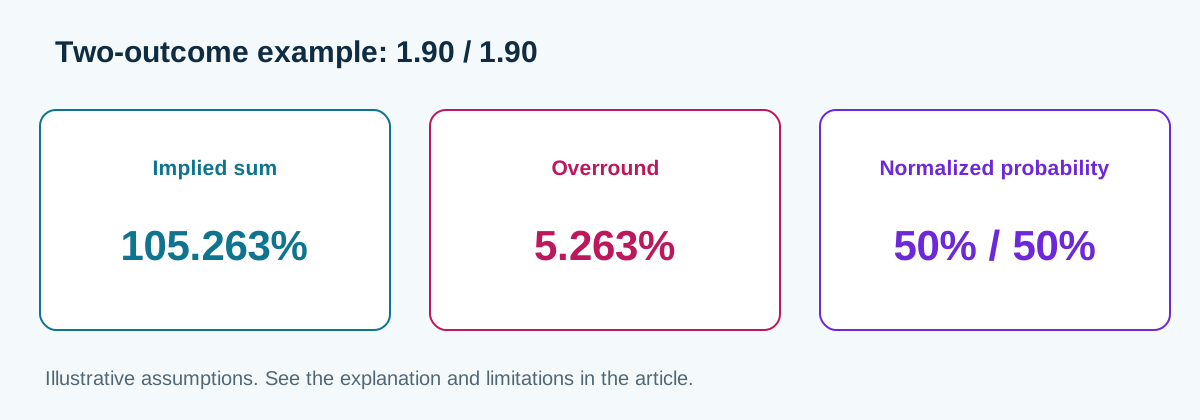
In a hypothetical symmetric market at 1.90/1.90, overround is 5.263%. At 1.83/1.83 it is 9.290%, while normalized hold is 8.5%. With an assumed true win probability of 0.53, a price of 1.83 gives EV=0.53×1.83−1=−3.01%. Proportional or Shin de-vigging produces model probabilities, not verified true probabilities. Esports Odds Converter
Part 2: Comparing Two Quotes
Comparing permitted operators can reveal a different accepted price for the same contract. Using more than one account does not itself create an edge, and one operator does not mathematically make profit impossible. Do not assume fixed margin, speed or limit characteristics from an operator category.
- 1win: record the actual quote, available stake and settlement terms for your account. No measured average margin or response time is established here.
- Stake: apply the same comparison. A crypto payment option does not establish instant withdrawal, higher limits or immunity from account restrictions.
If both operators are available under the applicable rules, compare the same selection and settlement conditions before interpreting their prices. At odds of 1.55 rather than 1.45, a winning one-unit ticket returns 0.10 more units. That payout comparison does not establish positive expected value or a particular profit over 100 wagers. Do not infer an operator advantage from a single illustration. The related comparison is here: Esports Margin Audit: 1win vs Stake
| Operator | Price | Rules | Stake availability | Payments |
|---|---|---|---|---|
| 1win | Record accepted quote | Check the same contract | Record account-specific amount | Check current conditions |
| Stake | Record accepted quote | Check the same contract | Record account-specific amount | Check current conditions |
Part 3: Data Hygiene and the 100-Bet Log
A consistent log preserves losses, voids and mistakes as well as wins. Retain the original entry when correcting an error so the review can distinguish an execution problem from a later change to the record. A spreadsheet is useful because it lets another person reproduce the arithmetic.
Every single wager during your first 100 bets must be recorded in an electronic spreadsheet or ledger with these mandatory fields:
- Bet ID & Date: Numeric sequence (1 to 100) and exact timestamp.
- Match & Tournament: Specific event (e.g., ESL Pro League, BLAST Premier).
- Market & Selection: Specific market (e.g., Match Winner, Map 1 Round Handicap +3.5).
- Odds Taken: The exact decimal odds secured when the bet was submitted.
- Closing benchmark: source, actual timestamp, both sides where needed and the chosen de-vig method. Missing data remain missing.
- CLV: a comparison of accepted and benchmark prices under the stated definition, not proof of true edge.
- Result & Profit/Loss: Settled outcome (+0.95 units, -1.00 unit, or push).
Review realized ROI and CLV separately. A 65% CLV beat rate does not prove that a losing record was only bad luck; a 35% rate does not predict the next 200 outcomes either. The sizes of the price differences and their stake weights matter. For example, 55 differences of +0.1% and 45 of -1% have a negative unweighted mean of -0.395% despite a 55% beat rate. Examine benchmark quality, correlations and uncertainty before drawing a conclusion. Keep the log and compare the explanation: Esports Bankroll Tracker Closing Line Value in Esports
For an explicit independent-leg example, suppose every leg has expected gross return 0.94 per unit. Two legs return 0.94², a net expectation of −11.64%; three return 0.94³, or −16.9416%. This assumes a 6% expected loss per leg, not a 6% booksum overround. Correlation and settlement rules change the calculation.
Part 4: Reviewing the First 100 Records
At the end, review the record for missing fields, deviations from the chosen stake rule and benchmark problems. These checks help diagnose the exercise. They do not form a certification for larger stakes, and there is no need to place additional bets merely to reach a count.
- Stake-rule review: flag any deviation and retain it in the log. Investigate the cause rather than deleting the record or restarting the count to conceal losses.
- Rule 2 (Benchmark review): Record how often and by how much prices beat the closing benchmark. A count of 55 out of 100 is not a validated pass mark or proof of predictive power. Keep stake-weighted differences and investigate errors before changing exposure.
- Behavior review: record whether the exercise led to chasing or disturbed normal activities. A calm run does not prove readiness to risk more capital.
Use the first 100 records to identify missing data, inconsistent stake sizing and errors in price comparisons. A disciplined process makes those problems easier to see; it does not by itself establish a profitable model or justify increasing the amount at risk.
A record that can survive a review
Give each entry an identifier and retain the event, exact market, quote, stake or simulated amount, forecast and observation time. Distinguish an accepted ticket from a rejected request and a void from a loss. Keep the original row when correcting a typo, with a note explaining the correction. Otherwise the first hundred entries can become a cleaned-up story rather than a record of the decisions actually made.
Review arithmetic and the decision process separately from the final profit. Check whether the market and price matched the forecast, whether the limit was respected and whether new information appeared after submission. Count all entries under the rule chosen in advance, including inconvenient losses and paper decisions. Reaching an arbitrary count does not establish readiness to raise stakes or replace other income. If a long gap or incomplete record prevents comparison, state that limitation instead of resetting the history until a favorable sequence appears.