
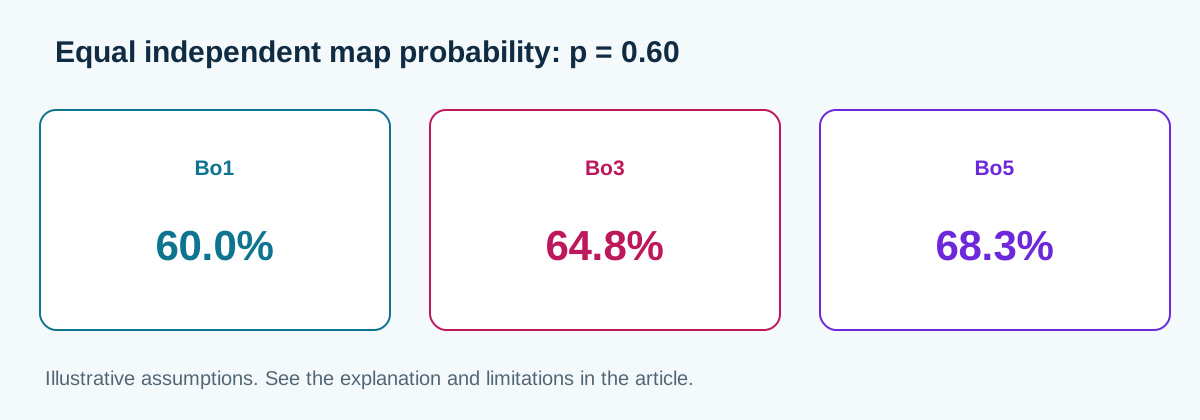
Most esports bettors start with the series moneyline. It is the headline market and the most heavily promoted, and it feels like the cleanest expression of a handicapping opinion: "I think Team A is better, so I back Team A." But the series moneyline is a composite price. It bundles three separate events (Map 1, Map 2, and a possible decider), each with its own tactical context, into one number. When you bet the composite, you accept the bookmaker's assumptions about every component, including the ones where you have no edge.
1. The Core Mathematical Formula: Linking Map Probabilities to Series Probability
Define p1, p2, and p3 as the probabilities that a given team wins Map 1, Map 2, and Map 3 respectively. The simplest model assumes each map is independent. Under that assumption, a team wins a best-of-three in exactly three ways: win-win, win-loss-win, or loss-win-win. See also: Bo3 and Bo5 series probabilities (EsportsMath).
The comparison below is a set of hypothetical models, not the result of a 1000-match backtest. No map-first strategy is asserted to outperform series betting. A concentrated map estimate can favour one contract, while different prices can reverse the choice. Keep probability sensitivity separate from financial EV. A series may amplify a uniform probability advantage, but the offered series price can already charge for it. A single map removes some exposure, but its own price may be worse.
Hypothetical independent-map Bo3, Team A probabilities
p1=.58; p2=.18; p3=.32
P(2-0)=p1*p2=.104400
P(2-1)=[p1*(1-p2)+(1-p1)*p2]*p3=.176384
P(1-2)=[p1*(1-p2)+(1-p1)*p2]*(1-p3)=.374816
P(0-2)=(1-p1)*(1-p2)=.344400
P(series win)=.104400+.176384=.280784
P(Map1 win)=.58
EV(series at3.50)=.280784*3.50-1=-.017256
EV(Map1 at1.92)=.58*1.92-1=.1136
What sensitivity does and does not show
In the example, A has a 58% chance on Map 1 and only 28.0784% in the series because the other inputs are weak. Map 1 at 1.92 has conditional EV +11.36%; the series at 3.50 has −1.7256%. This is a price-specific comparison. If the Map 1 quote fell to 1.60, its EV would be −7.2%. The team did not become worse; the contract became more expensive. Do not use a high historical map win rate as if it were the next-match probability against any opponent.
The partial derivative for Map 1 is p2 + p3 − 2 p2 p3, which equals 0.3848 here. Changing only p1 by 0.085 changes series probability by exactly 0.032708 in this independent-map model. This is not a universal 55–70% loss of ROI. For constant p, the series function is 3 p² − 2 p³ and its derivative at 0.50 is 1.5. Both derivatives describe probability changes under specified assumptions. To compare money, evaluate the available price of each market separately.
Unknown vetoes and conditional paths
Before a veto, the map contract may refer to several possible maps. Weight the probability over those scenarios instead of silently assuming your preferred pick survives. A team can change bans, the opponent can remove the signature map, or the event can use a different procedure. After the veto, update from the confirmed order. In Dota 2, game-level context comes from rules, side, pick order and draft rather than a CS2 map pool. For draft restrictions in other titles, use the exact event version rather than assuming a universal Fearless rule.
Independence is a baseline assumption, not a measured fact about momentum. If later-map probabilities depend on earlier results, write those conditional values explicitly. Preparation, side selection, substitutions and draft availability may change the state. Do not assume every decider is a coin flip or every favourite must be shrunk by a fixed factor. A decider can be one team’s best surviving map. Shrinkage needs a defensible target and validation; uncertainty about a parameter is not the same as Bernoulli outcome variance.
General conditional Bo3 path identity
a=P(W1)
bW=P(W2|W1); bL=P(W2|L1)
cWL=P(W3|W1,L2); cLW=P(W3|L1,W2)
P(series win)=a*bW+a*(1-bW)*cWL+(1-a)*bL*cLW
Independent-map special case: bW=bL=p2; cWL=cLW=p3
This identity does not estimate any conditional input.
Capital duration and a conditional hedge
An earlier settlement can release capital sooner, but the time saving is not an automatic growth multiplier. Use actual settlement times and available future opportunities, not universal map durations. A settled bet can also release less money after a loss. Compare expected cash flows and concurrency before claiming capital efficiency. A sufficiently funded account may be constrained by acceptable prices and limits rather than time. Do not create extra bets merely to recycle a stake. Shorter duration cannot turn a negative EV into a positive one.
For a separate hedge example, take an already accepted 100-unit series ticket at 3.50. After A wins Map 1, retain p2 = 0.18 and p3 = 0.32 in the independent model. Then A’s remaining series chance is 0.4424. If B can actually be backed at 1.65 under matching rules, 350/1.65 equalises terminal profit at 37.878788. This requires 212.121212 additional units. The accepted positions reduce outcome variation, but the hedge has negative conditional EV and gives up 16.961212 expected units versus holding the original ticket.
Hypothetical hedge on the same series, compatible settlement
pAfterW1=.18+.82*.32=.4424
originalStake=100; originalReturn=350; hedgeOdds=1.65
hedgeStake=350/1.65=212.121212121212
lockedProfit=350-100-hedgeStake=37.878787878788
unhedgedExpectedProfit=.4424*350-100=54.84
hedgeEVperUnit=(1-.4424)*1.65-1=-.07996
expectedCost=54.84-37.878787878788=16.961212121212
Equalised terminal returns do not remove rejection, partial acceptance or mismatched void rules. Rebuild the portfolio after each actual confirmation. A cash-out offer is another available trade, not the same thing as the model’s fair value. Compare its certain amount with state-dependent alternatives and the risk budget, including the extra capital required. Do not make a later hedge a prerequisite for surviving an oversized initial stake. Price each later map afresh using the information then available rather than treating the first win as proof of momentum.
What a valid comparison would need
To test map selection against series selection, define both decision rules before collecting results. Use the same information cutoff, probability model, cost treatment and eligible matches. Preserve contemporaneous prices and accepted capacity. Avoid using a completed veto or final lineup that was unavailable at the supposed entry time. Report every forecast, skipped bet, rejection and void. Compare realised profit, calibration and risk with uncertainty, not only win rates. CLV adds benchmark price evidence but cannot certify true EV. Without such a dataset, the examples remain teaching models and the claimed superiority remains untested.
Check one final distinction in the log: a forecast for a map that is never played is not a losing forecast automatically. It may be a void ticket or an unobserved conditional event, according to the contract. Keep conditional predictions separate from settled outcomes. This matters when comparing map strategies with series strategies, since the two logs may contain different opportunities rather than competing predictions of the same event.